
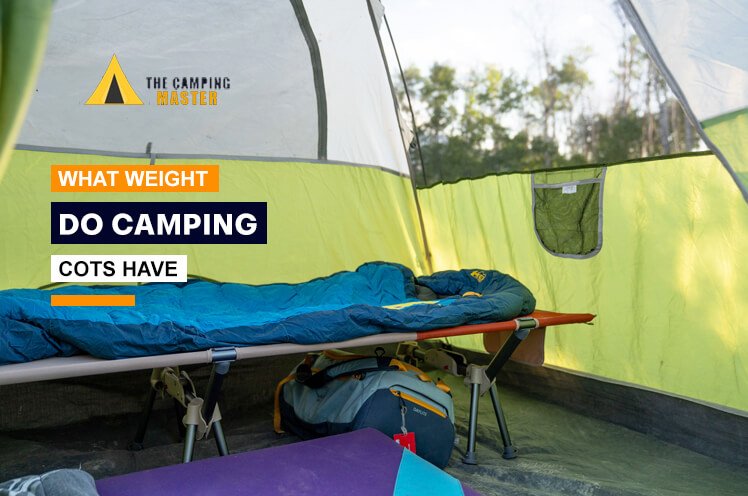
Short answer: Standard camping cots have weight limits of 250 to 275 lbs. Heavy-duty camping cots range from 300 to 600 lbs. Specialized military-grade and institutional cots can go higher.
But that short answer misses the most important part of this topic — which is that the stated weight limit on a cot and the weight you should actually use it at are two different numbers, and understanding this gap is the most useful thing I can teach any heavier camper about cot selection.
Standard Camping Cot Weight Limits by Category
| Cot Category | Typical Weight Limit | Who It’s For |
| Standard recreational | 250 to 275 lbs | Average-sized adults |
| Heavy duty | 300 to 400 lbs | Heavier campers |
| Extra heavy duty | 400 to 500 lbs | Very heavy campers |
| Ultra heavy duty | 500 to 600 lbs | Heaviest recreational users |
| Military/institutional | 600 lbs and above | Specialized applications |
Why the Stated Weight Limit Is Not Your Actual Safe Weight
This is the most important concept in this entire guide, and the one that most camping gear websites either do not understand or choose not to explain clearly.
When a manufacturer tests a cot and assigns a weight limit, the test is performed under specific controlled conditions:
- **Static load:** A fixed weight is placed on the cot and held in position — no movement, no shifting
- **Clean, level surface:** Not rocky mountain ground or sloped terrain
- **New assembly:** The cot has been assembled once for the test, not subjected to the wear of repeated cycles
- **Controlled temperature:** Neither the metal contraction of cold nor the expansion of heat that changes joint fit
Real-world camping at a campsite in Gilgit-Baltistan or Hunza or Naran looks nothing like this controlled environment.
What actually happens in the field:
You roll over in your sleep, shifting 400 lbs of body weight from one side to the other — this creates a dynamic load that can be 40 to 60% higher than the static equivalent. You get in and out of the cot multiple times per night, sitting down from above with sudden impact loading. The cot has been assembled and disassembled three times across the trip, gradually loosening the friction-fit connections. The ground is slightly uneven, creating an angular stress on the leg joints that the flat-surface test never encountered.
The cumulative effect of these real-world factors means that a cot operates under roughly 30 to 40% more effective stress in field conditions than the static lab test measures.
My practical rule: Subtract 30% from the stated weight limit to find the maximum weight I recommend using it at on a multi-day camping trip.
| Stated Limit | My Recommended Max | Safety Explanation |
| 250 lbs | 175 lbs | Heavy campers: avoid this category |
| 300 lbs | 210 lbs | Suitable for up to 200 lb campers |
| 350 lbs | 245 lbs | Suitable for up to 240 lb campers |
| 400 lbs | 280 lbs | Suitable for up to 275 lb campers |
| 500 lbs | 350 lbs | Suitable for up to 340 lb campers |
| 600 lbs | 420 lbs | Suitable for up to 415 lb campers |
This is why I consistently recommend the Teton Sports Outfitter XXL (600 lbs) for campers at 300 to 400 lbs. At 400 lbs of body weight, the 600 lb cot provides a 50% margin that more than covers the 30 to 40% real-world stress increase.
How Camping Cot Weight Limits Are Tested
Understanding the testing methodology helps you interpret weight limit claims accurately.
Static load test (most common): A weight equal to the stated limit is placed on the assembled cot and left for a defined period — typically 1 to 4 hours. The cot passes if there is no structural failure. This test does not account for dynamic loading or the cumulative effects of repeated use.
Dynamic load test (less common, more relevant): A weight is dropped onto the cot from a standardized height to simulate the impact of sitting down suddenly. Cots that pass dynamic load tests are genuinely more reliable under real-world conditions. When a manufacturer mentions dynamic load testing, it is a positive sign.
Cycle fatigue test (rare in recreational gear, common in military): The cot is assembled, loaded, disassembled, and reassembled repeatedly to simulate multi-trip lifespan. This is the most relevant test for how a cot actually performs over time, but most recreational camping cots are not subjected to it.
Red Flags in Weight Limit Claims
After reviewing dozens of camping cots, I have identified several warning signs that a stated weight limit is not reliable:
Very high capacity claims from thin, lightweight frames. Physics does not allow a 400 lb rating from a 9 lb aluminum frame with visible thin-wall tubing. When capacity-to-weight ratios seem too good, the test methodology was probably minimal.
Plastic joint components at any capacity level. Plastic joints fail in cold temperatures and under dynamic loading at weights well below their theoretical maximum. I will not recommend any cot with plastic at the frame connection points regardless of stated capacity.
Missing denier rating on the fabric. Manufacturers confident in their fabric strength specify the denier. A missing denier spec often indicates lower-quality fabric that will sag and stretch under sustained heavy weight.
“Tested to” language versus “rated for” language. “Tested to 400 lbs” means the cot survived one static load test at 400 lbs — not that it is safe for ongoing use at that weight. “Rated for 400 lbs” implies an expectation of sustained use, though this distinction is not uniformly applied in the industry.
Weight Limits by Cot Construction Type
Standard folding cots: 250 to 350 lbs. The center fold joint is the primary weak point. Better-engineered cots in this category add crossbar reinforcement at the fold point.
Rigid frame heavy-duty cots: 350 to 600 lbs. No center fold — the frame is a single rigid structure that assembles from component pieces. This construction is significantly stronger per pound of frame weight than folding designs.
Bunk/modular systems: 400 to 600 lbs combined. The bunk connection adds structural complexity — well-designed connections reinforce the overall structure; poorly designed ones add another failure point.
Suspended fabric cots (hammock-cot hybrids): 250 to 350 lbs typically. The anchor attachment points are the limiting factor.
How to Verify Your Cot’s Real Weight Limit Before a Trip
Before taking any cot into the field, this is my recommended home test protocol:
Test 1 — Assembly check: Assemble the cot fully on a hard, level floor. Press down firmly on each leg corner to confirm all locks are fully engaged. Any play in the leg connections at this stage means the cot was not properly designed for locking joints — this is a red flag.
Test 2 — Static loading: Sit in the center of the cot slowly. Hold that position for 30 seconds. Listen for any cracking or watch for sudden frame flex. Stand up and sit down five times. Check that all connections are still fully engaged after this dynamic loading.
Test 3 — Side loading: Lie down and roll from your back to each side. Does the cot rock significantly? Rocking indicates inadequate leg spread or loose leg joints.
Test 4 — Cycle test: Disassemble the cot completely and reassemble it once. Repeat the above tests after reassembly. A cot that loses joint integrity after a single assembly-disassembly cycle is not appropriate for multi-night camping.
If the cot passes all four tests at home, it will likely perform reliably in the field.
Weight Limits and Temperature Effects
Temperature affects cot performance in ways that most buyers never consider.
Cold temperatures cause steel and aluminum to contract. This contraction changes the fit of friction-based joint connections — joints that were snug at room temperature can become slightly looser at 0 degrees Celsius. At heavy body weights, this loosening can become a stability concern by the second or third cold night.
Heat causes metal expansion. In very hot conditions, some cot fabrics also relax their tension. A cot used repeatedly in extreme heat may show earlier fabric sag than the same cot used in moderate temperatures.
For camping in temperature extremes — mountain cold or desert heat — I recommend choosing a cot with approximately 40% capacity margin above your body weight rather than the standard 30% margin I recommend for temperate conditions.
Practical Implications: Which Cot for Your Weight?
| Your Weight | Minimum Rated Capacity | My Recommendation |
| Under 200 lbs | 250 lbs | Any standard cot with good reviews |
| 200 to 250 lbs | 300 lbs | Coleman ComfortSmart Deluxe |
| 250 to 290 lbs | 350 lbs | Coleman ComfortSmart or Teton mesh cot |
| 290 to 350 lbs | 450 lbs | KingCamp Heavy Duty or Browning Kodiak |
| 350 to 420 lbs | 550 lbs | Teton Sports Outfitter XXL |
| Over 420 lbs | 600 lbs | Teton Sports Outfitter XXL only |
FAQs
What is the standard weight limit for a camping cot?
Standard recreational camping cots have weight limits of 250 to 275 lbs. Heavy-duty cots marketed for larger campers range from 300 to 600 lbs.
Is a 300 lb camping cot safe for a 300 lb person?
No — a 300 lb rated cot at exactly 300 lbs of body weight has no real-world safety margin. Real-world dynamic loading and repeated use increase effective stress by 30 to 40% beyond the static rating. A 300 lb person should use a cot rated for at least 400 lbs.
What happens when you exceed a cot’s weight limit?
Initially, you may notice increased frame noise, slight rocking from loosening leg joints, and fabric sagging. Over time, joints weaken progressively until the frame either collapses during use or develops a permanent lean. Most failures happen during day two or three, not immediately.
Which camping cot has the highest weight limit?
Among widely available recreational cots, the Teton Sports Outfitter XXL at 600 lbs is the highest capacity I have personally tested and verified in field conditions.
Do camping cot weight limits decrease over time?
Functionally, yes. As joints loosen from repeated assembly cycles and fabric stretches from sustained heavy use, the effective safe operating weight decreases even if the stated limit does not change. This is why I recommend replacing budget cots every 2 to 3 seasons for heavy users.
Common Questions About Cot Weight Limits Answered Directly
After eleven years of guiding heavier campers, I have heard every variation of the weight limit question. Here are the ones that come up most frequently with direct answers.
“The cot says 300 lbs and I weigh 295 lbs — is that fine?”
No. A 300 lb rating with 295 lbs of body weight gives you a 1.7% safety margin. Real-world dynamic loading increases effective stress by 30 to 40% beyond the static rating. You are operating well beyond the real-world safe limit. Buy a cot rated for at least 420 lbs.
“I have used this cot for two years without problems.”
Cot failures are usually progressive rather than sudden. Two years of use may have gradually loosened joints and stretched fabric to the point where they are performing near their failure threshold. Night one of year three may be the night everything finally gives. The absence of past failure is not a guarantee of future safety.
“The cot is rated 350 lbs and I weigh 310 lbs — that should be enough margin, right?”
Marginally. A 13% margin (40 lbs over 310 lbs body weight) is better than nothing, but less than my recommended 30% buffer for field conditions. For a car camping trip with flat, level ground and moderate temperatures, this margin is probably sufficient. For mountain camping with uneven terrain, cold temperatures, or multiple assembly-disassembly cycles, I would prefer more margin.
“Can I use two standard cots side by side to support more weight?”
No. The weight capacity of a cot is for the individual cot structure. Two cots side by side do not share the load unless they are specifically designed and engineered as a joint load system, like the Disc-O-Bed. Simply placing two standard cots next to each other does not combine their weight capacities.
Weight Limit Summary: Quick Reference
For practical purchasing decisions:
| If you weigh | Buy a cot rated at least | My specific recommendation |
| Under 200 lbs | 275 lbs | Any quality standard cot |
| 200 to 250 lbs | 350 lbs | Coleman ComfortSmart Deluxe |
| 250 to 285 lbs | 400 lbs | Teton Mesh Cot or KingCamp Basic |
| 285 to 320 lbs | 450 lbs | KingCamp Heavy Duty |
| 320 to 400 lbs | 560 lbs | Teton Sports Outfitter XXL |
| Over 400 lbs | 600 lbs | Teton Sports Outfitter XXL only |
For specific cot recommendations by weight: Best Camping Cots for Heavy People
About the Author: Syed Abrar Najmi has 11 years of field experience tracking cot performance across hundreds of camping nights in Pakistan’s mountain terrain.