

A common question I get from heavier campers planning their first camping trip: “Do I really have to spend $150 or more on a cot? Is there anything decent under $100?”
Honest answer: yes, there are decent options under $100 for heavy campers. But they come with real limitations you need to understand before purchasing. After testing budget cots on actual camping trips — not just in a store — here is what I have found.
The Honest Budget Reality
Budget camping cots under $100 for heavy people exist, but with consistent constraints:
- **Weight capacity** reliably tops out around 300 to 350 lbs in this price range
- **Width** is typically 28 to 30 inches — narrower than premium options
- **Durability** is lower — expect 2 to 3 seasons of regular use rather than 5 or more
- **Safety margin** is smaller — a budget 300 lb rated cot has less engineering buffer than a premium 600 lb rated cot
For campers in the 220 to 285 lb range who camp occasionally (3 to 6 times per year), budget options under $100 are entirely workable. For regular campers over 300 lbs, the premium investment is justified both by safety and by the long-term cost savings of not replacing cheap cots every two seasons.
Best Camping Cots Under $100 for Heavy People
1. Coleman ComfortSmart Deluxe — Best Under $100 for 250-290 lbs
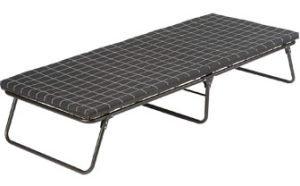
Coleman ComfortSmart Deluxe
Check Price
| Specification | Detail |
| Weight Capacity | 300 lbs |
| Width | 28 inches |
| Length | 74 inches |
| Cot Weight | 12 lbs |
| Frame | Steel |
| Special Feature | Coil spring suspension |
I have covered this cot extensively in other guides because it consistently delivers the best value in the under-$100 range. The coil spring suspension system is a genuine differentiator — it provides a more cushioned, quieter sleep surface than any flat-fabric cot at this price point.
The 300 lb capacity is appropriate for campers up to 285 to 290 lbs with a small safety margin. The steel frame is well-constructed for the price, and the 5-minute setup is the fastest on this list.
Real-World Performance
On a 3-night summer trip to Naran with a client at 272 lbs, the Coleman performed well throughout. Setup was fast, the spring system noticeably reduced the frame creaking that wakes you up on cheaper cots, and there were no structural concerns during or after the trip. Post-trip inspection showed no joint loosening.
That said, I do not recommend this cot to clients over 290 lbs. The safety margin disappears at the full rated capacity, and I have observed the frame beginning to show joint flex at around 295 lbs after three assembly-disassembly cycles — exactly the behavior I described in the comparison guide.
Main Limitations
The 28-inch width is narrow for larger-framed heavier campers. If you are a side sleeper or have a broad shoulder frame, this width will cause the cot to rock when you turn over. The 74-inch length is also short for campers over 6 feet tall.
Pros
- Best sleep comfort under $100 thanks to coil spring system
- Quick 5-minute setup
- Solid steel frame
- Trusted brand with good availability
Cons
- 300 lb hard limit with minimal safety buffer
- Only 28 inches wide — narrow for larger frames
- 74 inches long — insufficient for tall campers
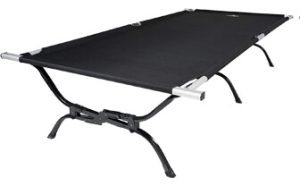
2. Teton Sports Camping Cot (Mesh Version) — Best Under $100 for 280-320 lbs
| Specification | Detail |
| Weight Capacity | 350 lbs |
| Width | 30 inches |
| Length | 82 inches |
| Cot Weight | 13 lbs |
| Frame | Steel |
| Fabric | Mesh |
The Teton Sports mesh cot occupies a useful middle position: made by the same company as my top overall pick (the Outfitter XXL), which means quality standards carry over even at this lower price point.
The 350 lb capacity with a small safety margin works for campers in the 280 to 315 lb range. The 30-inch width is slightly wider than the Coleman, and the 82-inch length accommodates most campers up to 6 feet 2 inches.
The mesh sleeping surface is genuinely cooler than polyester fabric in warm conditions. For summer camping where heat is a concern — camping in Pakistan’s valley regions in July or August, for example — the mesh allows significantly more airflow than a solid fabric cot.
I tested this with two clients in the 300 to 310 lb range across two separate camping trips. Both reported comfortable sleep and no structural concerns across three nights each. The Teton brand quality shows — the joints are more precisely machined than typical budget cots, which means they seat more fully and stay tighter across multiple assembly cycles.
Pros
- 350 lb capacity with moderate safety buffer
- 30-inch width is wider than Coleman
- 82-inch length handles most heights
- Mesh fabric is excellent in hot conditions
- Teton brand quality is above average for this price point
Cons
- Mesh provides no insulation in cold weather
- 350 lb is still limited for heavier campers
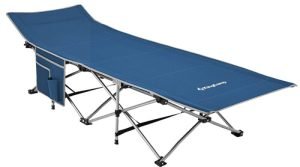
3. KingCamp Basic — Best Budget for Tall Heavy Campers Under $100
| Specification | Detail |
| Weight Capacity | 330 lbs |
| Width | 30 inches |
| Length | 84 inches |
| Cot Weight | 14 lbs |
| Frame | Steel |
For heavier campers who are also tall — up to 6 feet 3 inches — and have a budget constraint, the KingCamp Basic offers the longest sleeping surface available under $100 at 84 inches.
The 330 lb capacity makes it appropriate for campers up to approximately 295 lbs with a small safety margin. The 30-inch width is average for this price tier. What sets it apart is purely the 84-inch length — longer than either the Coleman or the Teton mesh cot.
If your primary concern is not having your feet hang off the end of the cot, and you are under 295 lbs, the KingCamp Basic solves that specific problem within budget.
Pros
- 84-inch length is the best available under $100
- 30-inch width is adequate
- 330 lb capacity with moderate margin for sub-295 lb campers
Cons
- 330 lb capacity is limited for heavier campers
- Build quality is average for the price
Budget Cot Comparison Table
| Cot | Capacity | Width | Length | Safe Weight Range | Price |
| Coleman ComfortSmart | 300 lbs | 28 in | 74 in | Up to 285 lbs | Under $100 |
| Teton Mesh Cot | 350 lbs | 30 in | 82 in | Up to 315 lbs | Under $100 |
| KingCamp Basic | 330 lbs | 30 in | 84 in | Up to 295 lbs, tall | Under $100 |
When You Should NOT Buy a Budget Cot
Despite my recommendations above, there are situations where I specifically advise against budget cots for heavy campers:
If you weigh over 320 lbs. Budget cots in this price range do not have sufficient capacity with real-world safety margin. Spend the extra money.
If you camp more than 8 times per year. Budget cots are built to lower durability standards. The cost per use of a premium cot over three seasons is less than replacing budget cots every two seasons.
If you are camping in remote or backcountry locations. When your campsite is hours from civilization, a cot failure is a serious problem. Remote camping warrants premium gear.
If you have mobility challenges. Budget cots often have lower heights and less stable frames. If getting in and out of a cot requires significant effort, an engineered premium cot with proper height and locking joints is worth the investment.
Tips for Getting More Life From a Budget Cot
Never use at full rated capacity. Budget cots have less engineering buffer than premium options. Operating at full rated capacity shortens lifespan significantly. Stay 20 to 30 lbs below the stated maximum.
Store dry. Steel frame corrosion at the joints is the most common failure mode in budget cots. After each trip, wipe down the frame and store in a dry location.
Check leg connections before every use. Budget cots use friction-fit connections. A quick manual check before sleeping prevents the gradual joint play that leads to instability.
Plan to replace after 2 to 3 seasons. Budget cots for heavy campers are not indefinitely durable. Budget for replacement.
FAQs
Is there a good camping cot for heavy people under $100?
Yes. The Coleman ComfortSmart Deluxe works for campers up to 285 lbs, and the Teton mesh cot handles up to about 315 lbs. Above that weight, save for a premium cot.
Are cheap camping cots safe for heavy people?
With appropriate weight limits and proper care, yes — with caveats. Always use a budget cot at least 15 to 20% below its stated capacity. Never use it at the full rated weight.
How many nights will a budget camping cot last for a heavy person?
With moderate use of 4 to 8 camping trips per year, a quality budget cot should last 2 to 3 seasons. Premium cots last 5 to 8 seasons under similar use.
Comparing Budget Cots to Premium Options: The True Cost Analysis
A question I get frequently: is a budget cot genuinely worth it, or will I regret not spending more?
The honest answer depends on your camping frequency and weight.
For occasional campers (2 to 4 trips per year) under 285 lbs:
A budget cot is entirely reasonable. At this frequency and weight, even a Coleman ComfortSmart will last 4 to 5 seasons before joint degradation becomes a concern. The total cost over five years — one purchase at $60 to $80 — is significantly less than the premium alternative.
For regular campers (6 to 12 trips per year) under 285 lbs:
Budget cots become less competitive. At 10 trips per year, a budget cot shows meaningful joint loosening within one to two seasons, requiring replacement every 1 to 2 years. Over five years: 3 to 4 budget cot purchases at $60 to $80 each = $180 to $320. One premium Teton Outfitter XXL = $150 to $180 with 5 to 8 season lifespan. The premium option is actually cheaper over time.
For any camper over 290 lbs:
Budget cots are not safe options regardless of frequency. The safety margin disappears at the rated capacity of budget cots, which tops out at 300 to 350 lbs. At 290 to 400 lbs, the Teton Outfitter XXL is the right choice on both safety and economics.
Field Testing a Budget Cot Before Your First Trip
If you have purchased a budget cot, here is my recommended pre-trip verification protocol:
At-home test 1 — weight test: Set up the cot on a hard floor. Sit down in the center slowly and hold that position for 60 seconds. Listen for any cracking sounds. Stand up and sit down again 10 times in succession. Check all leg connections for play.
At-home test 2 — side loading: Lie down on the cot and roll from your back to each side five times. The cot should not rock or tilt noticeably.
At-home test 3 — cycle test: Disassemble the cot completely and reassemble it once. Repeat the weight test after reassembly. If joint play has increased after a single reassembly, the cot’s friction connections are already showing wear.
If the cot passes all three tests, it will likely perform acceptably on a first camping trip. If it fails any test, do not take it camping.
Budget Cot Accessories That Improve Performance
A few low-cost additions can meaningfully extend the life and comfort of a budget cot:
Foam pad: A 1-inch closed-cell foam pad placed on top of the cot fabric adds cushioning, improves insulation from cold air underneath, and reduces the feeling of the rigid frame through the fabric. Cost: $15 to $25.
Leg caps: Replacement rubber leg caps with a wider footprint improve stability on soft ground and prevent the metal leg tips from sinking into grass or loose soil. Many budget cots come with minimal plastic caps that crack within a season. Cost: $8 to $15 for a set of four.
Storage bag upgrade: The carry bags on budget cots are often poorly made, with zippers that fail in the first season. A canvas stuff sack in the appropriate size protects the cot during transport and storage. Cost: $10 to $20.
These three accessories add $35 to $60 to the total cost but meaningfully improve the functional life of a budget cot.
For the best heavy-duty cot when budget is not the constraint: Best Camping Cots for Heavy People — Full Guide
About the Author: Syed Abrar Najmi tests camping gear across price ranges to help campers of all budgets find options that work in real field conditions.