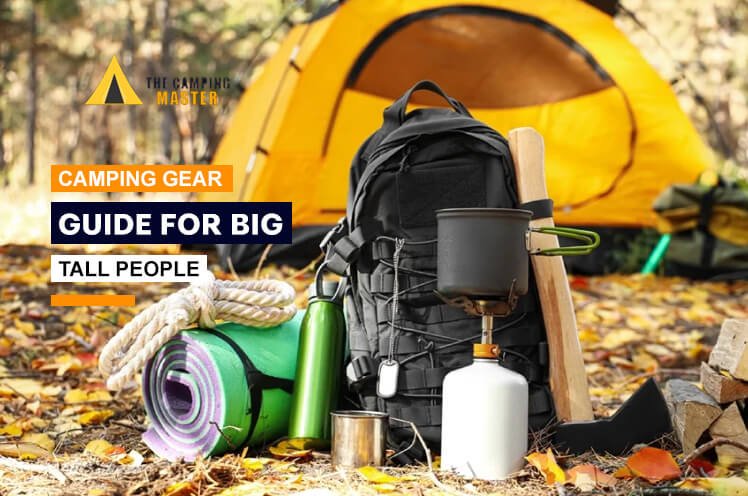
When I started running guided camping trips through Pakistan’s mountain regions over a decade ago, I noticed something that most outdoor gear brands still largely ignore: heavier and taller campers face gear challenges that standard equipment simply does not address.
A tent rated for four people barely fits two heavy adults with their gear. A hiking boot size that should work according to the manufacturer’s chart creates blisters after three kilometers. A rain jacket covers everything except the last six inches of a tall person’s wrists.
These are not minor annoyances. They are gear failures that turn a potentially transformational outdoor experience into a frustrating one. Over eleven years and hundreds of clients of varying sizes and builds, I have built up a clear picture of what big and tall campers actually need — and where standard gear falls short.
Check Complete Camping Gear Guide for Big and Tall People. This is guide brings together everything across all gear categories so you can shop once, correctly.
The Core Problem With Standard Camping Gear
Standard camping gear is designed for an imagined average user: approximately 5 feet 9 inches, 165 lbs, with average shoulder width, hip width, and foot width. Manufacturers optimize for this profile because it represents the largest single market segment.
When your measurements deviate significantly from this profile — you are taller, heavier, broader-shouldered, or have wider feet — you hit edge cases that standard gear was never tested for.
The result is predictable: tents that feel suffocating rather than cozy, sleeping bags that compress their fill and lose their warmth, cots that sag or fail, chairs that buckle, and boots that create blisters because the toe box is too narrow for a wider foot.
The solution is systematic: identify which categories of gear matter most for your specific combination of height and weight, and make targeted upgrades in those categories.
Sleeping System
Cot
The foundation of a big and tall camper’s sleep system is a properly rated, properly sized cot.
For heavy campers under 350 lbs: KingCamp Heavy Duty at 440 lb capacity and 87-inch length handles most big and tall combinations, particularly for taller campers.
For heavy campers over 350 lbs or for very broad frames: Teton Sports Outfitter XXL at 600 lb capacity and 40-inch width is the safest and most comfortable choice.
The two critical specifications for big and tall campers are length and width simultaneously. Most heavy-duty cots optimize for weight capacity but stay narrow (28 to 32 inches). Most long cots (85 to 90 inches) are not rated for heavy weights. The KingCamp and Teton are the two products that address both dimensions adequately.
Avoid cots shorter than 80 inches if you are over 6 feet tall. Your feet hanging off the end of the cot means you are pulling the foot section of your sleeping bag off your body, which results in cold feet regardless of the bag’s temperature rating.
Sleeping Bag
For big and tall campers, sleeping bag specifications matter in two dimensions:
Shoulder girth: Minimum 64 inches for most heavier campers, 68 inches for broader frames. Standard bags at 58 to 60 inches compress the fill material against the shell, reducing effective insulation by 30 to 40%.
Length: Minimum 84 inches for campers 6 feet tall, minimum 90 inches for campers 6 feet 3 inches and above.
My top pick for big and tall campers: Teton Sports Tracker +5 XL (68-inch girth, 90-inch length, +5°F rated).
Sleeping Pad (For Ground Camping)
For big and tall campers who use a ground pad rather than a cot, standard 20-inch wide sleeping pads are inadequate.
- **Width:** 25 to 30 inches minimum
- **Thickness:** 3 inches or more — less thickness compresses fully under higher body weight and provides no cushioning
- **R-value:** Minimum R4 for three-season camping, R6 or above for cold conditions
- **Weight rating:** Check that the pad is rated for your weight — many foam pads have unstated limits around 250 lbs
Tent Selection
The Person Rating Problem
The person rating on tents is optimistic even for average-sized adults. For big and tall campers, it is nearly useless as a guide.
My rule: Buy a tent rated two person categories above your actual group.
A solo big and tall camper: minimum 4-person tent. Two big and tall campers: minimum 6-person tent. Two big and tall campers with large cots: minimum 8-person tent.
The “person” rating assumes average adults with minimal gear in sleeping bags side by side. Big and tall campers need more floor space, more headroom, and more room to maneuver while dressing and organizing gear.
Key Specifications to Check
Peak height: Minimum 5.5 feet, with 6 feet or more strongly preferred. A tall person who cannot stand even partially upright in their tent makes every morning routine — dressing, packing gear, stretching — a frustrating exercise in contortion.
Floor space: Calculate your actual floor space needs. Your cot dimensions plus 12 square feet per person for movement and gear storage. A Teton XXL cot at 40 by 85 inches is approximately 24 square feet by itself.
Vertical walls: Cabin-style tents with near-vertical side walls maintain usable floor space all the way to the edges. Traditional dome tents with steep slopes lose significant usable floor area at the perimeter.
My top picks for big and tall campers:
| Tent | Person Rating | Floor Space | Peak Height | Best For |
| Coleman Skydome 8 | 8-person | 126 sq ft | 5’10” | Best value |
| REI Kingdom 6 | 6-person | 83.5 sq ft | 6’6″ | Best quality |
| Big Agnes Big House 4 | 4-person | 64 sq ft | 6’4″ | Two tall campers |
Footwear
Footwear is the single most common gear failure point I see with heavier clients. The wrong boots create blisters, ankle injuries, and knee pain that can end a trip entirely.
Width
Standard hiking boots come in medium width (D or B in US sizing). Many heavier adults have proportionally wider feet — not just longer. Look for boots labeled 2E (Wide) or 4E (Extra Wide). Narrow toe boxes cause blisters at the ball of the foot under sustained heavy use.
Ankle Support
At 300 lbs or above on uneven terrain, the lateral forces on your ankle with each step are significantly higher than at 170 lbs. Low-cut trail shoes provide insufficient support at this weight. Always choose mid or high-cut boots for any camping that involves walking more than a kilometer from the vehicle.
Midsole Stiffness
Soft foam midsoles (found in most casual trail shoes and lightweight hiking shoes) compress completely under higher body weights. Once fully compressed, the midsole provides no energy return, no arch support, and no cushioning. Look for boots described as “stability” or “motion control” category — these use denser, stiffer foam or a plate insert that resists full compression.
My boot recommendations for heavier campers:
| Boot | Width | Support | Best For |
| Merrell Moab 3 Wide | 2E/4E available | Mid | 3-season general use |
| Keen Targhee III Wide | 2E | High | Rocky technical terrain |
| Salomon X Ultra 4 Wide | 2E | Mid-High | Long days on trail |
Camp Seating
The camp chair requirements for big and tall campers are straightforward: minimum 400 lb capacity with 22-inch seat width, and seat height of 17 to 19 inches to allow easy entry and exit.
My top pick: Coleman Oversized Quad Chair — 600 lb capacity, 24-inch seat width, powder-coated steel frame.
For tall big campers who find standard chair heights low: the Browning Kodiak Chair at 19 inches off the ground is the best option for mobility. The extra height dramatically reduces the effort of getting in and out, which matters on a day where you are sitting down and standing up dozens of times at camp.
Camp Table
Standard camp tables are 24 to 28 inches tall. For a person who is 6 feet 3 inches or taller, this requires constant bending over a stove or eating surface — which creates lower back fatigue over a full camping day.
Look for camp tables with adjustable height legs that extend to at least 30 to 32 inches. This height allows a taller person to work at a comfortable standing height rather than a constant mild crouch.
Rain Gear
Standard rain jackets come in sizes up to XXL, but the proportions are designed for average height. A tall big person in an XXL jacket often finds adequate chest width but insufficient arm length — wrists are exposed when reaching forward or up.
Look for brands that offer Tall sizing alongside their standard sizing. REI, Columbia, and Patagonia all offer rain jackets in Big and Tall proportions with extended arm length and body length.
Backpack Fit
Torso Length
Backpacks are sized by torso length, not height. Measure from the C7 vertebra (the prominent bone at the base of your neck) to the iliac crest (top of your hip bone). This determines the correct frame size. Many tall people have longer torsos that require a Large or XL frame size — do not assume that a standard Large fits just because you are a standard Large in clothing.
Hip Belt
Heavier campers rely more heavily on hip belt load transfer than lighter campers — your hips should carry 70 to 80% of the pack weight. Most packs come with a standard medium hip belt that is too narrow to properly engage wider hips. Look for packs with an extended hip belt option, or brands that specifically offer extended hip belt sizing.
Quick Gear Checklist
| Item | Specification | My Pick |
| Cot | 400+ lb capacity, 30″+ width, 80″+ length | Teton Outfitter XXL |
| Sleeping bag | 64″+ shoulder girth, 84″+ length | Teton Tracker +5 XL |
| Tent | 2 size ratings above group, 6’+ peak height | Coleman Skydome 8 |
| Camp chair | 400+ lb capacity, 22″+ seat width | Coleman Oversized Quad |
| Hiking boots | Wide toe box, high ankle support, stiff midsole | Merrell Moab 3 Wide |
| Rain jacket | Big and Tall sizing with extended arm length | REI Co-op Rainier |
FAQs
What camping gear do I need as a heavy person?
The key upgrades are: a heavy-duty cot (400+ lb capacity), a Big and Tall sleeping bag (64″+ girth), a spacious tent (buy 2 size ratings above your group), properly rated camp furniture, and wide-fit hiking boots with high ankle support.
What tent is best for big and tall people?
Look for tents with peak height of at least 6 feet and floor space of at least 55 square feet per person. The REI Kingdom 6 (6’6″ peak), Coleman Skydome 8 (5’10” peak with 126 sq ft), and Big Agnes Big House 4 (6’4″ peak) are all good options.
Do hiking boots need to be different for heavy people?
Yes — heavier campers need boots with wider toe boxes, stiffer midsoles, higher ankle support, and robust outsoles. Lightweight trail runners appropriate for a 160 lb hiker do not provide adequate support or durability at 300+ lbs.
How do I find sleeping bag length for my height?
Add 6 inches to your height to find the minimum sleeping bag length. For a 6-foot-tall person, that is a minimum 78-inch bag length — though 84 to 90-inch Big and Tall options are preferable for comfortable sleeping with your head fully inside.
Quick Summary: What to Prioritize First
After helping hundreds of campers of all sizes, my consistent advice for first-time heavier campers: start with the cot and the camp chair. These two pieces directly affect physical comfort and safety. Get those right first and everything else is manageable.
The tent and sleeping bag matter too, but a slightly undersized tent is uncomfortable rather than dangerous. An undersized cot or chair is a safety risk. Prioritize in that order, then upgrade the rest as your camping routine develops.
A heavier camper who is properly equipped has exactly the same quality of outdoor experience as a lighter camper. The mountains and forests do not discriminate. Once the gear is right, everything else is just camping — which is exactly as it should be.
Frequently Asked Questions (Additional)
How do I know if my current camping gear is adequate for my weight?
Check the weight capacity of every load-bearing item you own — cot, chair, air mattress if applicable. If any item is rated within 25% of your body weight, upgrade it before your next trip. Items rated at more than 40% above your weight are in the safe zone.
What is the best way to store heavy-duty camping gear between trips?
Store cots and chairs fully disassembled in a dry location. Steel frames corrode at the joints when stored damp. Fabric should be clean and dry before packing — mildew in stored fabric is permanent. For sleeping bags, store uncompressed in a large mesh or cotton bag rather than the compressed stuff sack.
Can heavier camping gear be rented rather than purchased?
Most camping rental services do not carry heavy-duty gear. It is worth calling ahead to ask, but in my experience you will need to own your own properly rated equipment. The investment in quality heavy-duty gear pays for itself within two to three camping seasons.
See more: Best Camping Cots for Heavy People (400+ lbs)
About the Author: Syed Abrar Najmi has outfitted and guided hundreds of campers of all sizes through Pakistan’s outdoor terrain over 11 years.