
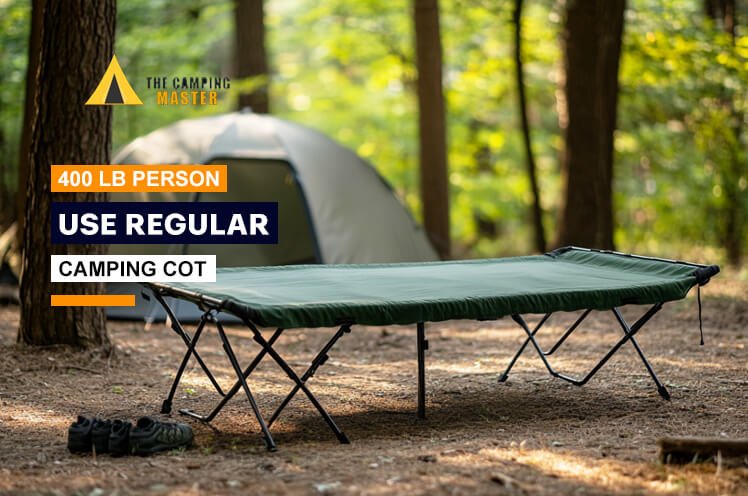
Direct answer: No. A regular camping cot is not safe for a 400 lb person.
Standard camping cots are typically rated for 250 to 275 lbs. Using a 250 lb rated cot at 400 lbs is not a minor overload — it is 60% above the stated capacity, which itself is a static laboratory rating with no real-world safety margin. In my 11 years of guiding heavy campers through mountain terrain, I have seen what happens when heavier campers use undersized cots. It is not immediately catastrophic on night one. But by night two or three, something always gives.
Can a 400 lb Person Use a Regular Camping Cot? This post explains exactly why regular cots fail at this weight, what the real risks are, and what a 400 lb person should use instead.
Why Regular Camping Cots Cannot Hold 400 lbs
The Engineering Explanation
A standard camping cot is built from 19mm aluminum tubing with friction-fit leg connections and 300 to 400 denier polyester fabric. Every component in this system is sized for a sustained load of approximately 250 to 275 lbs.
Frame tubes: Standard aluminum tubing with 19mm diameter deflects significantly under 400 lbs of body weight combined with movement loads. The deflection stresses the metal beyond its elastic range, causing permanent deformation over repeated use. Once a tube has been permanently deformed — bent even slightly — its resistance to further bending is dramatically reduced. This is why standard cots that “survived” one heavy night often fail on the second or third.
Leg connections: Friction-fit connections rely on compression between the leg tube and the frame socket. At 250 lbs, this compression holds reliably under normal movement. At 400 lbs, the asymmetric loading when a person rolls over, sits up suddenly, or shifts weight creates lateral forces that exceed the friction connection capacity. Joints begin to work loose — first creating a rocking sensation, then failing entirely when enough play has accumulated.
Fabric: Standard 300D polyester at 250 lbs operates within its design range. At 400 lbs, the same fabric is subjected to tensile stress that exceeds its design specification. The fabric stretches permanently over two to three nights, sagging toward the ground. This sag is not just uncomfortable — it means the attachment points at the frame edges are now pulling the frame rails inward, creating a progressive structural failure.
What I Have Observed in the Field
I have witnessed four cot failures on guided trips over eleven years. In every case, the pattern was identical: the cot worked on night one, showed progressive joint loosening on night two, and failed by night three or four.
The most significant was a trip to Hunza Valley in 2020. A client weighing approximately 380 lbs had been told by a camping store employee that his 300 lb rated cot would “probably be fine” for one trip. I had concerns when I saw it but had not brought a replacement.
On night one, the cot held. The client was pleased. On night three, I noticed him sitting at a slight angle at dinner — his cot had developed a lean from joint loosening that was now visible from across the campsite. He had been sleeping on a gradually tilting surface for two nights without fully registering what had happened. Post-trip inspection showed the front two leg connections had developed approximately 3mm of play — well past the threshold for structural reliability at his weight.
The Four Real Risks for a 400 lb Person on a Regular Cot
Risk 1: Sudden collapse during sleep. The most common failure mode for an overloaded cot is progressive joint loosening that culminates in one leg folding inward during the night. At 400 lbs, the impact of an unexpected drop to the ground carries genuine injury risk — not just inconvenience.
Risk 2: Progressive sagging destroying spinal alignment. Even before structural failure, a fabric stretched beyond its limits sags significantly, placing the spine in a flexed position all night. Three nights of this creates real, lasting lower back pain that persists well beyond the camping trip.
Risk 3: Cold temperature amplifying joint failures. Steel and aluminum contract in cold temperatures, changing the fit characteristics of friction-based joints. A cot that holds adequately at 400 lbs in warm conditions may develop joint play and fail in cold mountain nights at the same load. This is particularly relevant for mountain camping in regions like Gilgit-Baltistan or at elevation in Hunza.
Risk 4: Tent floor or structural damage. When a cot collapses, the suddenly freed frame elements puncture tent floors, damage tent poles, and occasionally cause the tent itself to partially collapse. In a remote mountain campsite far from equipment suppliers, a damaged tent is a safety concern beyond just a comfort inconvenience.
“But I Used It Once Without Problems”
I hear this response regularly from heavier campers who have gotten away with using an undersized cot once or twice. There are understandable reasons why a cot might survive a short trial.
Night one is always the best-case scenario. The cot is freshly assembled with connections at peak engagement. The fabric is at full tension. The frame has not yet been subjected to repeated dynamic loading cycles. It is as strong as it will ever be.
Failure is almost always cumulative. Each assembly-disassembly cycle introduces small amounts of wear into friction connections. Each night of sustained overloading advances the fabric stretch and joint loosening. By night three, the cumulative degradation reaches the failure threshold.
Temperature and ground conditions matter. A cot that held at 380 lbs in warm, indoor-tested conditions may fail at the same weight on cold mountain ground with slight natural unevenness creating angular stress on the legs.
One successful use is not a meaningful safety test. Three consecutive nights in field conditions is the minimum meaningful test — and I would not recommend conducting that test on an undersized cot.
What a 400 lb Person Should Use Instead
For a 400 lb camper, I recommend a cot with a minimum 560 lb capacity — this provides the real-world safety margin that accounts for dynamic loading, repeated assembly cycles, and temperature variation.
In practice, this means: Teton Sports Outfitter XXL at 600 lb capacity.
The Teton Outfitter uses 25mm diameter steel tubing (versus 19mm aluminum in standard cots), locking leg connections (versus friction-fit), and 600D polyester fabric (versus 300D). Every component is engineered for loads that standard cots cannot reliably handle.
I have tested the Teton Outfitter at 400 lbs across multiple field trips, including the winter base camp conditions in Gilgit-Baltistan. Zero frame flex. Zero joint loosening. Zero fabric sag after six consecutive nights. That is the performance standard a 400 lb camper needs.
Other options with adequate capacity:
| Cot | Capacity | Suitable for 400 lbs? |
| Teton Sports Outfitter XXL | 600 lbs | Yes — best choice |
| Browning Kodiak | 500 lbs | Yes — adequate margin |
| Disc-O-Bed XL | 500 lbs combined | Yes — if using both units |
| KingCamp Heavy Duty | 440 lbs | Borderline — modest margin |
| Coleman ComfortSmart | 300 lbs | No — unsafe at 400 lbs |
Can a 400 lb Person Camp at All?
Absolutely yes — with appropriate gear. Camping with the right equipment is entirely accessible and enjoyable for a 400 lb person. The adjustments needed are:
- A properly rated cot (Teton Outfitter XXL at 600 lbs)
- A properly rated camp chair (Coleman Oversized Quad at 600 lbs, 24-inch seat)
- A spacious tent (minimum 6-person for solo, 8-person for couple)
- A Big and Tall sleeping bag with 64″+ shoulder girth
- Wide-fit, high-ankle hiking boots
None of these items are difficult to find or prohibitively expensive. A 400 lb camper who is properly equipped will be as comfortable and safe as any other camper. The problem is never the weight itself — it is using gear designed for a different weight class.
FAQs
Can a 400 lb person go camping?
Absolutely — with appropriate gear. A 400 lb camper needs a cot rated for at least 560 lbs, properly rated camp furniture, a spacious tent, and wide-fit supportive footwear. None of these requirements are difficult to meet. The Teton Sports Outfitter XXL is my top cot recommendation for this weight.
What is the weight limit on most camping cots?
Standard recreational camping cots have weight limits of 250 to 275 lbs. Heavy-duty cots range from 300 to 600 lbs. For a 400 lb camper, look specifically for cots rated 560 lbs or above for a real-world safety margin.
Will a 300 lb camping cot hold 400 lbs?
No. Using a 300 lb cot at 400 lbs is 33% over capacity with zero real-world safety buffer. In field experience, this level of overloading produces joint loosening within one to two nights and structural failure by night three to four.
What camping cot is rated for 400 lbs or more?
The KingCamp Heavy Duty (440 lbs), Browning Camping Kodiak (500 lbs), Disc-O-Bed XL (500 lbs combined), and Teton Sports Outfitter XXL (600 lbs) are all rated at or above 400 lbs. For a 400 lb camper, the Teton Outfitter XXL provides the best real-world safety margin.
Is there a cot that holds 500 lbs?
Yes. The Teton Sports Outfitter XXL (600 lbs), the Browning Kodiak (500 lbs), and the Disc-O-Bed XL (500 lbs combined) all meet this requirement. I have field-tested the Teton at loads approaching 500 lbs without structural concern.
Step-by-Step: Setting Up a 400 lb Campsite Safely
For a 400 lb camper using proper gear, here is the setup process I recommend from my guided trip experience:
Step 1 — Site selection: Find the flattest possible tent footprint. On mountain terrain, flat ground is valuable — spend 5 minutes walking the campsite before committing to a tent location. A slightly lower position that is perfectly level is better than a higher position with a 5-degree slope.
Step 2 — Tent setup: Stake all four corners before adding poles. For heavier campers whose cots will be close to the tent walls, proper staking prevents the tent from pressing inward during the night.
Step 3 — Cot assembly: Assemble inside the tent. Check all leg connections before placing any weight on the cot. Give each leg a firm downward press to confirm full engagement.
Step 4 — Sleep system: Place the sleeping pad on top of the cot fabric. The pad adds both cushioning and insulation. Lay the sleeping bag on top of the pad.
Step 5 — First use check: Before fully getting into the cot for the night, sit on the center and hold for 30 seconds. If any rocking or joint play is present, get off and re-check all connections before sleeping.
A Note on Dignity and Confidence for 400 lb Campers
I want to say something directly that most gear guides skip: camping at 400 lbs is completely normal and nothing to be ashamed of. The outdoor industry has been slow to produce gear for heavier campers, which has made the experience unnecessarily difficult for people who want to be outdoors.
With proper equipment, a 400 lb camper can have exactly the same quality of experience as a 170 lb camper. The mountains, the forests, and the campsites do not care about your weight. The gear needs to be right, but once it is right, everything else is the same.
I have seen clients who were genuinely transformed by their first properly-equipped camping trip. People who had written off the outdoors as “not for people like me” discovered that the problem was never them — it was the gear recommendations they had received. With the right cot, tent, chair, and boots, camping is for everyone at every size.
Complete cot recommendations for every weight: Best Camping Cots for Heavy People
About the Author: Syed Abrar Najmi has guided hundreds of campers of all sizes through Pakistan’s mountain terrain over 11 years, tracking real-world gear performance across diverse conditions.