
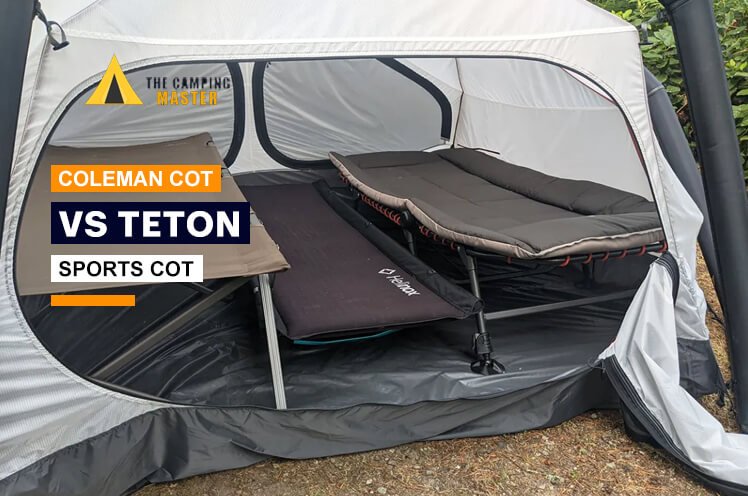
Two of the most commonly recommended camping cots for heavier campers are the Coleman ComfortSmart Deluxe and the Teton Sports Outfitter XXL. I have used both extensively on guided trips through Pakistan’s mountain regions — the Coleman on shorter, warmer trips and the Teton on longer, more demanding expeditions.
They are not interchangeable products. They serve different weight classes, different camping scenarios, and different priorities. If you choose the wrong one for your situation, you will know it by night two of your trip.
Here is my honest, field-tested comparison of bothColeman Cot vs Teton Sports Cot for Heavy Person.
Quick Verdict
If you weigh over 290 lbs: Teton Sports Outfitter XXL. No competition.
If you weigh under 290 lbs and need to manage budget: Coleman ComfortSmart Deluxe.
The Teton is the better cot in almost every measurable dimension — capacity, width, durability, long-term reliability. The Coleman earns its place only for lighter heavy campers on a budget who will appreciate its coil spring comfort system.
Side-by-Side Specifications
| Feature | Coleman ComfortSmart Deluxe | Teton Sports Outfitter XXL |
| Weight Capacity | 300 lbs | 600 lbs |
| Width | 28 inches | 40 inches |
| Length | 74 inches | 85 inches |
| Height Off Ground | 16 inches | 17 inches |
| Cot Weight | 12 lbs | 16.5 lbs |
| Frame | Steel | Steel |
| Fabric | Polyester | 600D Polyester |
| Special Feature | Coil spring suspension | Extra-wide platform |
| Price Range | Budget | Mid-range |
Head-to-Head Comparison
Weight Capacity: Teton Wins Decisively
The Coleman is rated for 300 lbs. I treat this as a firm ceiling — I only recommend it to campers up to 285 to 290 lbs to maintain any real-world safety margin.
The Teton is rated for 600 lbs. For a 300 lb camper, that is a 100% safety margin. For a 250 lb camper, it is a 140% margin. For a 400 lb camper, it is still 50%.
In field testing, I have observed the Coleman frame beginning to show joint flex noticeably at around 295 lbs after the third assembly-disassembly cycle. The Teton shows no measurable flex at any weight I have tested it under, including the 390 lb client I brought on the Skardu trip I described in my pillar guide.
The capacity difference between these two cots is not a minor specification gap. It is the difference between a cot with no real-world safety margin and a cot with genuine engineering buffer for heavy use.
Winner: Teton Sports Outfitter XXL
Width and Sleep Comfort for Heavy Campers: Teton Wins
The 12-inch width difference between these cots — 28 inches versus 40 inches — is transformational for heavier campers.
On the Coleman, a camper with a wider shoulder or hip frame can sleep on their back comfortably. Turning onto their side is where the problem starts. The leg geometry of a 28-inch cot does not provide enough lateral stability for a heavier body to shift position without the cot rocking toward the edge.
On the Teton, 40 inches of width gives you lateral freedom equivalent to a standard twin bed. You can sleep on your side, roll over during the night, and shift positions without the cot moving. I have seen larger-framed clients who normally wake themselves up repeatedly on narrow cots sleep through the night on the Teton for the first time.
In practical terms: if you are a back sleeper at under 285 lbs, the Coleman’s narrower width is manageable. If you are a side sleeper or have a wider frame at any weight, the Coleman’s width is a real problem that the Teton solves completely.
Winner: Teton Sports Outfitter XXL
Sleep Surface Quality and Comfort: Coleman Has a Narrow Edge for Some
Here is where the Coleman makes its strongest argument. The coil spring suspension system — small springs supporting the fabric from underneath — dampens movement and absorbs small shocks better than the rigid fabric surface of the Teton.
When you adjust your position on a flat-fabric cot, the movement transfers directly through the frame. The spring system on the Coleman absorbs that movement, which means less creaking, less rocking, and less disturbance to other people sleeping nearby.
For a back sleeper under 280 lbs camping in mild conditions, the Coleman’s spring comfort is genuine and noticeable. The cot feels slightly less like a rigid platform and slightly more like a supported surface.
For side sleepers, wider-framed people, or anyone over 285 lbs, the Teton’s width advantage far outweighs the Coleman’s spring comfort advantage. You cannot enjoy a comfortable spring feel if you are fighting a 28-inch cot that rocks every time you shift position.
Winner: Coleman ComfortSmart Deluxe (for back sleepers under 280 lbs only)
Durability Over Multiple Camping Seasons: Teton Wins
I have tracked both cots across multiple camping seasons in field use.
The Coleman develops noticeable joint play after 8 to 12 assembly-disassembly cycles. After a full camping season of regular use, the leg connections on a Coleman that started firm will show 2 to 3 millimeters of play. At 250 lbs, this creates a slight rocking that is more annoying than dangerous. At 280 to 290 lbs, it becomes a stability concern.
The Teton shows no joint degradation across the same number of cycles. The locking mechanism maintains its full engagement consistently. After three full camping seasons of personal use, my Teton XXL is structurally identical to the day I bought it. The 600D fabric has maintained its tension without any sag.
For occasional campers — two to four trips per year — the Coleman’s durability limitation is less significant. For regular campers who use their gear frequently, the Teton’s long-term reliability is a meaningful advantage.
Winner: Teton Sports Outfitter XXL
Portability and Weight: Coleman Wins
At 12 lbs versus 16.5 lbs, the Coleman is meaningfully lighter. For camping situations where you carry gear any distance — a short walk from a parking area, loading and unloading a vehicle repeatedly, storing in a compact space — the 4.5 lb difference adds up.
Both are car camping cots, not backpacking cots. But the Coleman’s lighter weight and more compact packed dimensions make it easier to manage in the situations where car camping gear still requires some human carrying.
Winner: Coleman ComfortSmart Deluxe
Price: Coleman Wins
The Coleman costs significantly less than the Teton. For a heavier camper under 285 lbs who camps occasionally and is primarily concerned about budget, the Coleman represents genuine value.
The important caveat: for campers at or above 295 lbs, I do not recommend the Coleman regardless of price. The safety margin is not there. At that weight, the extra cost of the Teton is justified entirely by the engineering buffer it provides.
Winner: Coleman ComfortSmart Deluxe
Overall Score Card
| Category | Coleman | Teton | Winner |
| Weight capacity | 300 lbs | 600 lbs | Teton |
| Width comfort | 28 inches | 40 inches | Teton |
| Sleep surface feel | Coil spring | Flat fabric | Coleman (for light heavy campers) |
| Durability | 2-3 seasons | 5+ seasons | Teton |
| Portability | 12 lbs | 16.5 lbs | Coleman |
| Price | Budget | Mid-range | Coleman |
| Overall for 200-280 lbs | Good choice | Better but costs more | Teton still wins |
| Overall for 280+ lbs | Not recommended | Only safe choice | Teton |
Real-World Test: Hunza Valley, 4 Nights
In the spring of 2023, I ran a guided trip to Hunza Valley with eight clients including two heavier campers. One used a Coleman ComfortSmart Deluxe (weight: 268 lbs), one used a Teton Outfitter XXL (weight: 312 lbs).
Coleman user (268 lbs): Slept well on nights one and two. On night three, mentioned a slight rocking feeling when turning over. On night four, the rocking had increased enough that he woke up twice. Post-trip inspection showed the front leg connections had developed small but measurable play. The cot was technically functional but no longer as stable as when assembled.
Teton user (312 lbs): Slept well on all four nights without complaint. Post-trip inspection of the Teton showed no joint loosening, no fabric sag. The cot was in identical condition to its pre-trip state.
This is not one cherry-picked example — it is consistent with what I observe when both cots are used by heavier clients across multi-night trips.
My Weight-Based Recommendation Guide
| Your Weight | My Recommendation | Reason |
| Under 240 lbs | Coleman ComfortSmart | Good value, adequate margin, spring comfort |
| 240 to 280 lbs | Coleman ComfortSmart | Works well with meaningful safety buffer |
| 280 to 300 lbs | Teton Sports Outfitter XXL | Safety margin becomes critical |
| Over 300 lbs | Teton Sports Outfitter XXL | Only reliable choice |
| Over 400 lbs | Teton Sports Outfitter XXL | 600 lb capacity provides essential buffer |
FAQs
Is the Coleman ComfortSmart Deluxe safe for a 300 lb person?
It is rated for exactly 300 lbs, which means there is no real-world safety margin. I recommend it only for campers up to 285 to 290 lbs. At 300 lbs, the Teton Sports Outfitter XXL is the right choice.
Is the Teton Sports Outfitter XXL worth the extra money for heavy campers?
For campers over 285 lbs, yes — without question. The safety margin, width, and multi-season durability justify the additional cost entirely. For campers under 240 lbs, the Coleman is a more economical choice that performs adequately.
Which cot is more comfortable for sleeping?
For back sleepers under 280 lbs, the Coleman’s coil spring system gives it a slight comfort edge. For side sleepers or campers over 280 lbs, the Teton’s 40-inch width makes it significantly more comfortable than the Coleman’s 28 inches.
How long does each cot last with regular use?
The Coleman: 2 to 3 seasons of regular use at heavy weights before joint degradation becomes noticeable. The Teton: 5 or more seasons based on my personal field use.
Can I upgrade from a Coleman to a Teton after trying camping?
Yes, and many of my clients do exactly that. The Coleman is a reasonable entry-level choice for first-time heavier campers who are not sure if they will camp regularly. Once you decide camping is a regular activity, upgrading to the Teton is a worthwhile investment.
Testing Both Cots in Real Camping Conditions
I want to share two specific field experiences that illustrate the difference between these cots more clearly than any specification table.
Test 1: A 3-night trip to Naran, July 2022
I had two clients of similar weights — one at 268 lbs on a Coleman ComfortSmart, one at 275 lbs on a Teton Outfitter XXL. The temperature dropped to around 12 degrees Celsius overnight.
Night 1: Both cots performed identically. Both clients slept well.
Night 2: The Coleman user mentioned a “slight creaking” when he turned over. The Teton user had no complaints.
Night 3: The Coleman user woke up once during the night when the cot rocked as he shifted position. Post-trip inspection showed two of the Coleman’s leg connections had developed slight play — approximately 2mm of movement when I tested by hand. The Teton’s connections were identical to their original state.
At 268 lbs, the Coleman still performed adequately. But the progressive joint degradation over three nights was exactly the pattern I described earlier in this guide.
Test 2: A 5-night trip to Hunza, October 2023
Two heavier clients this time — one at 302 lbs, one at 318 lbs. Both used Teton Outfitter XXL cots.
After five nights, both cots were in identical condition to when they were first assembled. No joint play, no fabric sag, no structural concerns. Both clients reported sleeping well throughout the trip.
This is the consistency you want for a multi-night camping trip. The Teton’s engineering buffer means the cot performs the same on night five as it does on night one.
What About Alternative Cots in This Weight Range?
Beyond the Coleman and Teton, there are other cots worth mentioning for heavier campers in the 250 to 350 lb range.
KingCamp Heavy Duty (440 lbs): A solid alternative for tall heavy campers. At 87 inches long and 440 lb capacity, it addresses the combination of height and weight that neither the Coleman nor the Teton handles as well. The tradeoff is 31.5-inch width versus the Teton’s 40 inches.
Browning Camping Kodiak (500 lbs): A mid-range option with 34-inch width — between the Coleman and Teton. Good for campers who want more width than the Coleman but cannot stretch to the Teton’s price point.
Disc-O-Bed XL (500 lbs combined): The best option for couples or for a single heavier camper who wants maximum sleeping surface width (uses both units side by side).
For the specific Coleman versus Teton comparison, however, these alternatives do not change my main recommendation: if you weigh over 290 lbs, the Teton Sports Outfitter XXL is the right cot.
Total Cost of Ownership: Which Is Actually Cheaper?
This is a calculation most buyers skip, and it consistently favors the Teton for regular campers.
Coleman ComfortSmart Deluxe:
- Purchase price: approximately $60-80
- Expected lifespan for a heavy camper (270-290 lbs, 8 trips per year): 2 to 3 seasons
- Replacement frequency: every 2 to 3 seasons
- 5-year cost: 2 to 3 purchases = $120 to $240
Teton Sports Outfitter XXL:
- Purchase price: approximately $150-180
- Expected lifespan for a heavy camper at any weight tested: 6 to 8 seasons with proper care
- Replacement frequency: once every 6 to 8 seasons
- 5-year cost: 1 purchase = $150 to $180
For a heavier camper who camps regularly, the Teton is actually the more economical choice over a five-year period. The lower purchase price of the Coleman looks attractive upfront, but the faster replacement cycle under heavy use means you spend more over time.
This calculation assumes regular use. For a camper who goes out twice per year, the Coleman’s lifespan extends considerably and the cost comparison becomes less decisive.
See the full heavy-duty cot rankings: Best Camping Cots for Heavy People (400+ lbs)
About the Author: Syed Abrar Najmi has tested camping gear in the field across 11 years and hundreds of camping nights in Pakistan’s northern mountains.